NewsDigestFollow

Curiosity Rover Frees Drill-Attached Rock on Mars

🏷️ Science & Space🔗 3 sources30Digest ScoreiThis score reflects the story's reliability, bias neutrality, and public momentum.
Curiosity Rover Frees Drill-Attached Rock on Mars

📰 Full Story

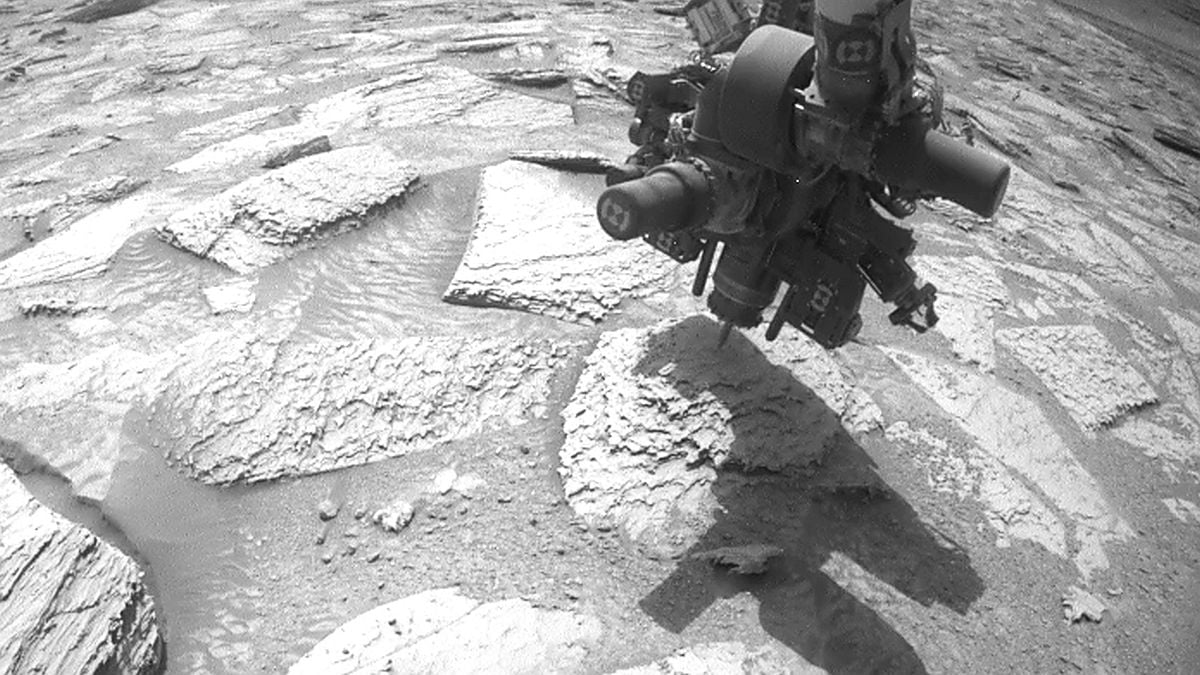
NASA’s Curiosity rover unintentionally pulled a slab of rock free when it drilled into a rock nicknamed “Atacama” in Gale Crater on April 25, 2026. Atacama is estimated about 1.5 feet across, six inches thick and roughly 13 kilograms (28.6 pounds). When Curiosity retracted its arm the entire slab remained stuck to the fixed sleeve surrounding the rotating drill bit — a situation not previously seen in the mission’s 13-plus years. Engineers on Earth first tried vibrating the drill; a second attempt on April 29 caused sand to fall but did not free the slab. On May 1 the team reoriented the arm, tilted and rotated the drill while running vibrations and spinning the bit; the rock fractured and fell away on the first iteration. Imagery of the event was captured by Curiosity’s hazard and navigation cameras. The rover was built and is operated by NASA’s Jet Propulsion Laboratory (Caltech) as part of the Mars Exploration Program. The episode highlights both the rover’s continuing scientific work and the operational challenges of remote sample collection on Mars.

Researchers trigger 8,000 controlled quakes under Swiss Alps

🏷️ Science & Space🌍 Switzerland🔗 4 sources26Digest ScoreiThis score reflects the story's reliability, bias neutrality, and public momentum.
Researchers trigger 8,000 controlled quakes under Swiss Alps

📰 Full Story

Researchers at ETH Zurich and European partners have for the first time induced thousands of tiny, monitored earthquakes deep beneath the Swiss Alps as part of the Fault Activation and Earthquake Rupture (FEAR-2) experiment. Working in the BedrettoLab — a facility carved into a 5.2 km ventilation tunnel beneath about 1.5 km of mountain — teams injected 750 cubic metres of water into boreholes over four days in late April, remotely controlled from Zurich. The injections produced roughly 8,000 seismic events on the targeted fault and on nearby perpendicular faults, with local magnitudes ranging from about -5 to -0.14. The experiment fell just short of its magnitude-1 target; researchers plan another attempt in June to refine injection angles. No surface shaking was detected and scientists say the activity added only a small fraction of natural risk. The project aims to improve understanding of fault mechanics and to guide safer underground activity such as geothermal development, mining and wastewater disposal.

Tiny Kuiper Belt Object May Have Atmosphere

🏷️ Science & Space🌍 Japan🔥 Trending🔗 5 sources3Digest ScoreiThis score reflects the story's reliability, bias neutrality, and public momentum.
Tiny Kuiper Belt Object May Have Atmosphere

📰 Full Story

A tiny trans-Neptunian object beyond Neptune, cataloged (612533) 2002 XV93, appears to be encircled by an ultra-thin atmosphere, according to a study led by Ko Arimatsu of Japan’s National Astronomical Observatory published in Nature Astronomy in May 2026. Observers at three Japanese sites monitoring a January 10, 2024 stellar occultation recorded a gradual dimming of starlight — a refractive signature consistent with a gaseous envelope rather than a sharp occultation edge. The putative atmosphere is extremely tenuous, roughly 5 million to 10 million times thinner than Earth’s atmosphere and an estimated 50–100 times thinner than Pluto’s. Possible sources include recent cometary impact or active cryovolcanic outgassing, though alternative explanations such as rings were considered less consistent with the data. Authors call for independent verification — particularly spectroscopic follow-up with facilities like NASA’s James Webb Space Telescope — to confirm composition and persistence. Senior planetary scientists, including Alan Stern, have urged caution pending more observations.

Blue Origin lander clears major NASA tests

🏷️ Science & Space🌍 United States🔗 4 sources2Digest ScoreiThis score reflects the story's reliability, bias neutrality, and public momentum.
Blue Origin lander clears major NASA tests

📰 Full Story

Blue Origin’s uncrewed Blue Moon MK1 lander, Endurance, has completed a full environmental test campaign inside NASA’s large Thermal Vacuum Chamber at Johnson Space Center, agency and industry accounts said in early May 2026. The campaign simulated deep-space vacuum and extreme temperature cycles to validate electronics, thermal systems and structure ahead of an uncrewed Commercial Lunar Payload Services (CLPS) demonstration mission that will carry two NASA science payloads. Separately, a full-scale Blue Moon Mark 2 crew cabin mock-up is now operational at Johnson for human-in-the-loop training and design feedback as NASA prepares for orbital rendezvous and docking tests targeted for 2027 and crewed lunar returns in the following years. Blue Origin plans to launch its lander on its New Glenn rocket, but New Glenn’s flight status and schedule remain subject to an FAA investigation of a recent second-stage failure, a factor that could affect timelines. Key qualification steps still required include autonomous navigation, cryogenic propellant handling, precision landing and ascent back to orbit before any crewed missions.

NASA pushes Mars helicopter rotors past Mach 1

🏷️ Science & Space🌍 United States🔗 3 sources2Digest ScoreiThis score reflects the story's reliability, bias neutrality, and public momentum.
NASA pushes Mars helicopter rotors past Mach 1

📰 Full Story

NASA engineers at the Jet Propulsion Laboratory in Southern California have tested next-generation Mars helicopter rotor blades in a simulated Martian atmosphere and driven rotor-tip speeds beyond Mach 1. During a 137-run campaign concluded in March, teams mounted a three-bladed rotor in JPL’s 25-Foot Space Simulator, evacuated the chamber and backfilled it with carbon dioxide to Martian pressures, then increased rpm and headwinds until tip speeds reached Mach 1.08 at about 3,750 rpm. That regime boosted lift by roughly 30%, a gain that could allow future aircraft to carry heavier science instruments, larger batteries and longer-duration flight systems. A two-bladed SkyFall rotor design reached comparable tip speeds at about 3,570 rpm. The rotors, built by AeroVironment, were tested to assess structural integrity near the sonic edge and to inform designs for the agency’s next-generation Mars aerial vehicles.

Study: Older adults report fewer intense regrets

🏷️ Science & Space🌍 United States🔗 3 sources1Digest ScoreiThis score reflects the story's reliability, bias neutrality, and public momentum.
Study: Older adults report fewer intense regrets

📰 Full Story

A study published online May 7, 2026 in the journal Emotion finds older adults report fewer recent regrets and experience less intense negative emotion when reflecting on past mistakes than younger adults. Researchers led by Julia Nolte surveyed 90 U.S. adults aged 21 to 89, asking participants to list up to five recent regrets (past year) and five long-term regrets, then rate the emotions each evoked and whether they were regrets of commission (actions taken) or omission (missed opportunities). While both age groups reported a similar number of long-term regrets, older participants showed lower levels of “hot” emotions such as anger, embarrassment and irritation and were less likely to undertake active psychological repair. Younger adults reported more regrets of commission and were more likely to plan corrective actions. The authors note the findings could reflect age-related shifts in emotion regulation or generational cohort differences and call for further research to determine underlying mechanisms and broader generalisability.
Explore more on NewsDigest